
Monday, August 24, 2015


Today's Market
by Dr Invest

Ouch! Ouch! Ouch! say's Wile Coyote. Known for his scheming which always results in the ultimate fail, he races to the next opportunity to fail once again.  This circus of comedy is unfolding right now in our stock market. Here is some of the genius advice being offered by wall street and the news media:

Don't panic... uh, don't panic.... remember that you are a long-term investor. Just stay where you are. The Federal Reserve has been able to establish stable growth after spending FOUR TRILLION DOLLARS and you can trust that they will spend four trillion more to insure that your investment is safe. (This is Wile Coyote kind of thinking!)

Here are some actual quotes:

Still, despite the grim scene across global equity markets, many market participants see opportunities for those willing to ride out the storm.

Peter Kenny, chief market strategist at Clearpool Group, agreed as well, saying in a letter to clients Monday the he remains "positive" on U.S. equities overall.

El-Erian echoed that sentiment, noting, "this sharp downturn will eventually create interesting opportunities for investors.
 
(Another Wile Coyote misquote by the news media to make the sell-off seem insignificant.)

When El-Erian was asked about the falling market today he said: "the selloff will continue until one of two things happen: emerging markets put in place a policy circuit breaker or prices fall low enough to bring buyers back. How low? Low enough means a lot lower than here because they've been inflated well beyond fundamentals by central bank policies, so in order to bring people back in you've got to overshoot the fundamentals on the down side to induce people back in. We are still well above what would be warranted by fundamentals. There has been this enormous faith in central banks, and that faith in central banks means we have borrowed returns and growth from the future, hoping that central banks will be able to hand off to higher growth. That has not happened."

What I am Trying to Prove

The news media and wall street brokers are telling you what you want to hear. They are slicing and dicing the information and providing the private investors with pieces of information which would make it appear that great investment opportunities are ahead. It is true that great investment opportunities are ahead and that a downturn will create interesting investment opportunities, but that is after your portfolio has lost 50%.

Today is not a Buying Opportunity

Traditionally, we see a bounce after a market sell-off, but there is nothing "traditional" about the current stock market. As I have said previously, the market has been an artificial market since 2012 when Quantitative Easing began. What seems as business as usual is actually underpinned by the Federal Reserve. The four trillion in stimulus simply makes it appear that our economy is prospering. The sad part is that everyone knows that the economy is weak, but continue to sell investments to private investors, knowing that private investors are likely to experience significant losses. 

Brett Arends writes:

Don’t be surprised if stock markets stabilize or bounce back in the next couple of days. Markets are due at least a short-term rally after last week’s dramatic plunge. This usually happens after a sell-off, no matter what the next big move is going to be. It doesn’t mean anything.

But anyone who automatically assumes this is another easy “buying opportunity” is talking nonsense.

For the past couple of years, Wall Street’s perma-bulls have had it their way. They’ve been gloating openly as stocks went up and up and up, seemingly without pause.

It got to the point that those warning about valuations and danger signs had been mocked into silence — or were simply ignored.

Not now.

I don’t mean to be alarmist or to induce panic, but someone needs to tell the public that there is a plausible scenario in which the U.S. stock market now collapses by another 70% until the Dow Jones Industrial Average falls to about 5,000. The index tumbled more than 3% to 16,460 on Friday and over 1,000 points in early trading Monday.

Dow 5,000? Really?

For 30 years, stock prices have been increasingly boosted by financial factors: collapsing interest rates and Federal Reserve manipulation, culminating most recently in ‘quantitative easing.’

I’m not predicting that will happen, but contrary to what the bulls tell you, it cannot be completely ruled out. And even if that ranks as an outlier and a worst-case scenario, there are other, more likely scenarios where the Dow falls to somewhere between 10,000 and 12,000.

In other words, although this might be a buying opportunity, a serious reading of history suggests this sell-off might also be the beginning.

Let me say on the record that I am not joining the perma-bears or extreme doom-mongers. I am simply pointing out that the perma-bulls have taken their own arguments way too far. The stock market is not doomed to collapse to oblivion, as some hysterics keep claiming. But it is not certain to keep going up by 10% a year, either. All those claiming that every sell-off is a buying opportunity, and that stocks “always outperform,” are lying to you.

A true understanding of stock market history shows that Wall Street in the past has moved in long, long swings upwards and downwards, often taking years or even a generation or two. There is a great deal of evidence suggesting that the upward move that began in 1982 is one of them — and that the downward move that first began in 2000 has not ended.Read: Meet the market timer who said things would get ‘ugly’

As stock market historian Russell Napier points out in his book “Anatomy of the Bear,” on five occasions in the past 100 years — in 1921, 1932, 1949, 1974 and 1982 — those big downward moves have not ended until share valuations have fallen to just 30% of the replacement cost of company assets. That’s using a powerful, if little-known, economic metric known as Tobin’s q.

And, to cut to the chase, if Wall Street stocks followed the same path today, that would take the Dow down to about 5,000, and the S&P 500 Index all the way down to around 600. (The S&P 500 slumped more than 3% to 1,971 on Friday, extending the drop as much as 5.3% on Monday.)

Yikes.

The “q” is a valuation that they don’t even mention in the training manuals for the official “financial planner” and financial-analyst exams. Your money manager has probably never heard of it. Or, if he has, he probably ranks it with astrology and the mystic rantings of Nostradamus.

But the “q” happens to have by far the most successful long-term track record of any stock market indicator.

It’s been better than the price-to-earnings ratio or quarterly earnings forecasts or economic growth rates or long-term interest rates or Federal Reserve minutes.

Independent analysts — such as professor Stephen Wright at London University and Andrew Smithers at Smithers & Co., a financial consultancy in London — have tracked it back over 100 years.

And in the past there has been no better guide for the long-term investor. It’s been even better than the cyclically adjusted price-to-earnings measure, also known as the “Shiller PE” after Yale finance professor Robert Shiller (which also, incidentally, suggests U.S. stocks could plunge a long way from here).

The “q” looks at the net asset values of public companies and adjusts them for inflation. It makes some intuitive sense. Why would Widget Inc. be valued at $1 billion on the stock market if you could start the company from scratch for a lot less?

Right now, according to data from the U.S. Federal Reserve, the reading on the “q” is about 100%. (It was 106% at the last reading, on March 1, but the S&P 500 has fallen about 10% since then.)

Since World War II, the average “q” reading has been about 70%. So if Wall Street tumbled just to its modern average valuation, that would take the Dow Jones Industrial Average down to about 12,000.See: When the stock market last crashed, these sectors fared best

If we just look at the period 1949 to 1994 — in other words, before the gigantic, off-the-charts boom of the late 1990s — the historic average “q” reading for stocks was 57%. If the market falls to those levels, that would take the Dow to about 9,500.

And if the market fell to its historic bear market lows, namely 30% or so, that would mean a Dow of about 5,000.

Why might such a scenario happen? It’s not just about China, or Greece, or slowing earnings, or the “death cross” on Apple’s stock. It would be because, for the past 30 years, Wall Street stock prices have been increasingly boosted by financial factors: collapsing interest rates and Federal Reserve manipulation, culminating most recently in “quantitative easing.” But at some point, that game has to come to an end. When it does, it is possible — not certain, but possible — that valuation metrics could unwind all the way back down again.

Past performance, as they say on Wall Street, is no guarantee of future results. And that means there is absolutely no guarantee that share prices in the future will follow a similar path to the one seen in 1921, 1932, 1949, 1974 or 1982. I would consider that to be very much the outer range of possibilities.

The real reason to be worried right now isn’t that these scenarios are guaranteed or even likely. It’s that 99% of the people managing America’s money, probably including yours, assume that they are completely impossible. And no, they aren’t. Have you factored that into your plans?

Closing Thoughts

I would expect a head and shoulders signal to develop, but this is not always the case. I am thinking that a regular pattern of entry into a recession might be skewed by the Quantitative Easing by the Federal Reserve. But after careful examination of the varied chart patterns, I can't honestly recognize a pattern that fits. I don't know what I am looking at, and that makes me very uneasy. 

I don't know that this is the BIG ONE or the collapse of the economy as we know it. But a significant downtrend has developed. I think we will find a new bottom where consolidation will start again, but could continue to lower lows. If you  are not invested in the market, don't start investing now. Wait for a month or two and see where the market is at that time.

(Note: the above information is for entertainment purposes only and is not to be used in anyway as investment advice.)




Tuesday, August 11, 2015

Today's Market
by Dr Invest

A quick look at bloomberg.com leads one to believe that the economy has never been better. The FED is projecting a rousing and robust economic future, and the bevy of financial advisers and analysts are firmly committed to investing in a stock market that they claim is undervalued. One analyst reminded the viewers that you can never trust PE as a measurement of the value of a stock. Another analyst assured the viewers that BONDS would not move lower and would remain a great buy as deflation kept the price of oil low and no major changes in the interest rate would occur.

STAYING OUT OF THE MARKET

I asked a few friends about their view and whether now was a good time for them to invest. The unanimous response was "I'm staying out of the market for now!"  This is no surprise because in
spite of stock prices moving higher and higher, participation in the market is moving lower and lower.


This chart demonstrates that there is a declining VOLUME with rising PRICES in the S&P 500. Simply said, "Fewer people are participating in the stock market even though there are rising prices". This is because people generally are not fooled by the hype and are unwilling to participate in higher risks for financial losses. Those in the market are enjoying some great returns, but will suffer tremendous losses when a down turn finally hits.

INSTITUTIONAL INVESTORS IN REAL ESTATE

Calls that unemployment is at an all-time low and that our economy is finally responding in a robust way to the brilliant actions of the FED has created the belief that things are returning to normal. Black Rock, after the collapse of the housing bubble, began to purchase distressed properties across the U.S. As the price of housing increases, Black Rock will, along with other institutional companies, begin to divest their selves of this real estate.

The problem is that their is a "NEW NORMAL". For most people, their one and only real investment has been their home; now, retiring and needing income, there is a flood of real estate coming onto the market. Individuals and institutional investors will be seeking to sell their properties. When you have too many sellers, the price always goes down.

I live in the Austin, Texas area. My tax evaluation on a property has increased by 44% over the past two years. That is a rise of 44% in the increase of property taxes as well. Currently, there just isn't enough housing in our area, even though builders continue to build as fast as they can. But as more seniors begin to sell their homes, the panic to sell will drive the prices lower for housing in our area.


The above chart shows the peak of BOOMER YEARS being from 1958 until 1962. This means the largest number of seniors will be potentially selling their homes and down sizing over the next ten years. Expectations is a deflation in the real estate market.

THE TRUTH ABOUT DEBT

One of my favorite economist is Dr Lacy Hunt in Austin, Texas. His credentials go on and on, including his time spent on the Federal Reserve board. He knows the angles, but has begun to share just a bit of his perspective. Take a moment to listen on YouTube. Click Here for Dr Lacy Hunt

The Federal Reserve and our politicians have put us into a place that is becoming harder to get out of. Continued national debt and private debt has pushed us into a Japan like scenario at least and a Greece like scenario at worst. We can boast of the strength of the dollar, but only because all the other currencies are doing so poorly. In the next ten years, the interest in our U.S. debt alone will push us near bankruptcy. Even worse, to sustain current levels of spending growth would more than saturate our capacity to pay for all the benefits. Our average GDP since 1776 has been 3.8 and over the past decade we have averaged 1.9 GDP. Even that average of 1.9 GDP has been declining over the past two years.

WHAT TO DO

We will continue to see a flat to declining economy. There is no lift-off in the economy, only a continued lift-off wish used to get investors into a declining market. As hard as it might seem to stay light in stocks, keeping a larger cash position is a better choice at this time. After a market decline, then you can consider the stock position.

Wait for the 15%, 30%, even 50% fall in the market. Then you can re-enter a stock position. Once a recession begins, expect about a year or two in the decline. Most of all, use good judgment. In an era of experimental economics by the FED there are any number of poor outcomes.

(Note: the above information is for entertainment purposes only and should not be used in anyway to make financial decisions.)


Monday, July 20, 2015

Today's Market
by Dr Invest


There is a sadness when you consider that much of what seems legitimate news reports on the condition of our U.S. economy is simply false. This falseness is a collaboration between government, wall street, the banks, and the business news media.

If none of these sources are reliable, then who can we go to? Your investment adviser would seem to be the answer, but he is part of that collaborative circle and his major goal is to capture your investment portfolio and then sell it to... well, yes, "wall street".

So, the investor is fleeced by group of perpetrators who have collaborated together to take his hard earned wealth. Although I seldom speak about politicians, today I read that Hillary Clinton had revised her promise to only raise taxes no higher than 20% on the wealthy, and now believes that 30% or more would be fair. This, she believes, would force the wealthy to spend more money in training and hiring the unemployed. The point is that the fleecing continues under the pretense that investors are becoming filthy rich from their investments.

A Plethora of Evidence 

On almost every level our economy has and is failing. Regarding DEBT, our nation is ridiculously borrowing money. U.S. debt has doubled under the current president.  Other countries are selling their U.S. Treasuries. (selling the debt they purchased from the U.S.)  They are selling their U.S. treasuries because the dollar is at an all-time high and many of these countries need extra money. Regarding UNEMPLOYMENT, our government is claiming that we are now at a 5% rate of unemployment. This kind of technical, but if you used an older method (pre-obama) of counting the unemployed, we would have a 23% rate of unemployment. Regarding STOCK MARKET GROWTH, stock prices have risen dramatically, but with a falling participation in the market. (market volume) The stock market has never continued to climb with a falling volume. At some point, the energy dissipates and the market falls.

For Example: Imagine that only 100 people bid on IBM stock. Now there are 200 million people who are not interested in IBM stock, but these 100 buyers/bidders begin by looking at a price of $50. Two of them are willing to pay $51 while the others, who desperately want to make some money, see the price movement upward. Three others make a bid for $52. The original two make a bid for $53. Because these investors NEED TO MAKE MONEY, the price keeps climbing. There are only a few speculators who are moving the IBM stock upward. This takes us to the idea of PRICE TO EARNINGS RATIO, which is called, PE. Now PE determines how many years it will take for a stock to return value. A PE of 18, the average PE, would take 18 years. A PE of 27, which is where many stocks are valued in today's market would take 27 years to see its value returned to you. 

Dr. Robert Shiller of Yale, created what was called the CAPE to measure the PE ratio. He recently warned (two months ago) that the U.S. stock market was too rich (overvalued) and the PE ratios too high.

Now I can keep going from chart to chart and from subject to subject to show how the evidence points to a stalling economy. The government declared that all businesses will now pay for their full-time employees healthcare. Business answered that declaration by only giving employees 30 hours a week so they would be considered part-time employees. The result was less income for workers. The workers were PUNISHED for the government's solution to make private enterprise pay for their healthcare.

With Obamacare came new taxes and penalties. All of the companies participating in Obamacare are now asking for substantial increases in premiums because they can't make a profit from so few people participating in Obamacare. In 2016, once Obamacare is fully implemented, the full impact of Obamacare will be felt. Obama will be out of office, but blaming the failure of Obamacare on some political outcome.

In all fairness none of this is entirely the fault of the Obama Administration. In only a few short decades, our government of both Democrats and Republicans have managed to put us into debt for many years ahead. The answer is to cut benefits and cut government agencies, instead; our government is enlarging healthcare programs, agencies, and its footprint.

James Dale Davidson has made some interesting observations. In the enclosed video, he is trying to sell his newsletter. I wouldn't buy it, but some of his points are viable. Davidson Video

Ron Paul has also made a video which an investor really needs to see. ron paul

Again, it seems to me that more people are trying to fleece investors by selling them newsletters. That is no my game. But still, if you you understand that the market could turn ugly at any moment you will be better prepared to get out of your investments that will drop 50% to 70%.

My suggestion is to stay light and be prepared to move out of the market. Stop sells are key. You can't wait too long to get out, so if you have had a long run of great returns, you could sell if you loose 10% to 12%. Some would call this a market correction, but I would rather be out of the market wishing I was in, than to be in the market wishing that I was out.

Before a real downturn, there will be a series of ups and downs. Some will interpret the initial downturn as simply a market correction. People will see it as a buying opportunity so stocks will rebound for a while. But because there will not be enough momentum/growth, the market will return to its original downturn. This is were people will recognize that a real market downturn is underway.

Do I believe in the "end of days" market collapse? No! But it sure can feel like the "end of days". So the secret is being prepared. Get your chicken off the grill... get your money out of stocks. Protect your gains.

Finally, if you haven't been fully invested in the market, don't get into the market now. This is not the right time. Wait until there is a full market downturn. This could take any where from one to two years to fully unfold once a downturn has begun. Even a mild downturn could be 30% and a serious downturn will see losses nearing 50%.  So get out of the market quickly with a stop sell, stay out of the market until people seem really desperate and then begin to buy. You can buy VTI which is Vanguard's full market index and will not have to figure out which stocks to buy if you were building a portfolio.

Think about some of these ideas, but most importantly, become mentally prepared for a downturn.

(note: the above article is for entertainment purposes and in no way is to be used as investment advice.)


Thursday, March 26, 2015

Today's Market
by Dr Invest


In my last article, I alluded to consumer spending being down. This is because many corporations are only offering part-time jobs, which continue to be low-pay and circumvent the Obamacare ACA regulations. In the U.S. full-time employees must have their medical insurance paid by the corporation. (I know I'm being simplistic here, but there's not enough space to discuss ACA.) No one would argue that workers are being paid less, that inflation has been rising, that hidden taxes, fees, and medical insurance forced upon the U.S. populace has left families with less to spend at restaurants and stores. So consumer spending is down, affecting GDP and pulling down on economic recovery. 

Brian Louis recently wrote:

Empty stores from retailers that went out of business years ago -- such as Borders Group Inc., which had big floor plans that are hard to fill -- are dotting shopping centers across the country at a time the rest of the commercial real estate market has rebounded. They’re now going to be joined by thousands of additional stores that will soon be vacant as retailers such as RadioShack Corp. file for bankruptcy and department-store operators including J.C. Penney Co. and Macy’s Inc. cut locations to save money.

Vacancies at U.S. regional malls rose to 8 percent in the fourth quarter from 7.9 percent a year earlier, partly because of Sears Holdings Corp. store closures, according to Reis Inc. The real estate recovery for neighborhood and community shopping centers has “remained at a snail’s pace,” the New York-based research firm said in January.

Retailers and restaurateurs said last year they planned to close 5,483 locations, more than double the 2,592 in 2013, which was a record low, according to a report by the International Council of Shopping Centers and PNC Financial Services Group Inc. Last year’s total was the highest since 2010, according to the study.

Since then, retailers including apparel chains Wet Seal Inc. and Cache Inc. have filed for bankruptcy. Fort Worth, Texas-based RadioShack, with about 4,000 locations, sought protection from creditors on Feb. 5.

More troublesome for landlords than the relatively small Wet Seal and RadioShack locations are the spaces being abandoned by J.C. Penney and Macy’s. Replacement tenants will be difficult to find for those stores, with their large footprints. Macy’s Inc., based in Cincinnati, said in January that it will cut 14 of its approximately 790 Macy’s store locations within a few months. Plano, Texas-based J.C. Penney said it would close 40 stores around the U.S. this year.

Today's headline that unemployment has never been lower is admirable, but says little about the real condition of our economy. We may well see a dramatic recovery from yesterday's dramatic losses in the market, but the underlying economic sickness remains. Since 2012, when stimulus and bond buying began, our economy has been on life support. It is only a matter of time before economic conditions slip lower and a dreaded recession wipes away trillions in stock gains and the dreams of financial security.

(note: the above article is for entertainment purposes only and not to be used in anyway as financial advice.)

Wednesday, March 25, 2015

Today's Market
by Dr Invest


Only now have analyst begun to admit that there are flaws in our U.S. economy, and only after a continued troubling downturn in the market. Shiller, professor at Yale, acknowledged that he was getting out of U.S. stocks, later saying that investors were continuing to invest in stocks out of fear. Stocks, he said, are the only game in town and that investors were exchanging risks for returns.

David Rosenberg took a step back to highlight four of the biggest obstacles facing the bull market.
Rosenberg, a typically bullish analyst  outlined:
  1. Earnings momentum has slowed. Bottom-up consensus forecasts for S&P 500 operating earnings growth in the first quarter have fallen to -3.1% from +5.3% year-over-year. "The second quarter has been sliced to -0.7% YoY as well, so technically speaking we could be looking at a mild profits recession here in the US – this is down from the +5.9% estimate at the start of the year," he wrote.
  2. Valuations are high. The trailing P/E ratio is 20x, compared to the long-run norm of 16x. "It actually is not all that uncommon to see the equity market up in years when EPS growth is flat-ish (as the consensus now believes for 2015) but that requires price-to-earnings multiple expansion."
  3. Economic data has been disappointing. The Citigroup Economic Surprise Index is at the lowest level since August 2011, and in that month, the S&P 500 dipped in a way that led some to think the economic cycle was turning.
  4. The strong dollar is hurting profits. "There is such a thing as too much of a good thing," Rosenberg wrote, and the dollar bull market is not over. He advised investors to avoid sectors that have EPS forecasts below zero, including Utilities (-6.6%) and Telecom (-0.8%.)

Up until last week, no analyst would acknowledge these grim figures. There was only the acknowledgement of a economy reaching velocity to break free of the recessionary levels held the past five years. Even president Obama touted how strong the economy had become under his leadership with employment reaching new highs. The problem is that the improvement in employment has come in part-time jobs that are relative low pay. Companies, seeking to avoid paying for the healthcare of full-time employees have begun to offer only part-time positions. Now heads of households must hold two part-time jobs and then those jobs pay less. When those jobs are recorded, they are recorded as though two people are now employed, when only one person has two jobs.

You may have a short memory, but back in the recession of 2008 there was a change in the way statistics were reported that made the GDP appear more robust, a kind of rewriting of the rules. Most of these changes were because of politics, so our economy would appear more robust. 

The reality is that people are making less income and they are being taxed more. Rules have been rewritten in the U.S. tax code so you pay more... more in fees if you don't have medical insurance... more in fees if you sell a second home (NIT), fees called medicare surtax, and redefining pretax income. (For instance, before 2014 your company could pay for your heath insurance and it would not be counted as income to you. Now the $10,000 to $15,000 your company pays for your health insurance must be added to your total income. So if your company paid $10,000 for your health insurance and your salary was $50,000 a year.... your total income would now be reported as $60,000. Effectively, your are being taxed more, even if taxes were not raised.)

Taxes put a drag on growth. Add to the mix a over valued dollar and declining consumer purchases and you have a recipe for disaster. So hold on to your hats, because the wind is picking up. Politicians and Wall Street brokers will continue their mantra that the economy is taking off. Don't believe it!

(note: the above information is for entertainment purposes only and not to be used in anyway as investment advice.)

Tuesday, March 10, 2015

Today's Market
by Dr Invest

Let me reiterate, we have been in a recession since 2012. The Federal Reserve, shrewdly used money printing (Liquidity) to float the economy. You will remember that in May of 2012, Bernanke, the then head of the Federal Reserve, began Quantitative Easing (QE). This inflated a market that was then in recession and is still in recession. The recession that began in 2012 never really ended. All of the QE would have caused remarkable INFLATION, excepting that we were in a RECESSION. The recession mean people receiving less INCOME. With less income and less consumer spending, there were less TAX REVENUES. City governments, State governments, and our National government suddenly found their selves short of the money needed for government programs. Numerous cities filed for bankruptcy. Even some state governments neared bankruptcy and were only pulled back by radical spending cuts.

THE CRY FOR INCREASING MINIMUM WAGE HAD NOTHING TO DO WITH COMPASSION, RATHER TO GAIN MORE TAXES FOR GOVERNMENT. It is loathsome to couch compassion for the poor under paid worker on the seat of self gain. This government's greatest concern is that business are not increasing the salaries of their workers. Is this because of their great humanitarian concern? No! This is because if companies would only increase salaries, the government could collect more taxes. Now if there is legislation to raise your taxes, you will likely call your Congressman immediately. But this kind of taxation is far more subtitle.

The implement a national healthcare insurance program (Obamacare) that BIG BUSINESS will have to pay for. This is hidden form of TAXATION. Increase minimum wage on BIG BUSINESS. This is a hidden form of TAXATION. Fees for people not wanting national healthcare insurance. This is a hidden form of TAXATION. If you own a second home and you sell it, there is a FEE that is paid into OBAMACARE. That is a hidden form of TAXATION. There are many other FEES that have been implemented on tobacco, alcohol, or luxury purchases, all amounting to a hidden form of TAXATION. There are a number of FEES yet to be implemented, but they are forms of HIDDEN TAXATION.

Businesses are buying back their stock and investing in their plants. Yet, these same businesses are cutting less desirable workers, hiring more desirable workers, and keeping their profits abroad. The government is begging them to hire more workers, but they are saying no! The government is begging them to bring their profits home, but they are reluctant to do so. The government's interest is not for the companies to reinvest in the U.S., but to TAX those companies, so government can continue to expand. It is the LACK OF FUNDS that keep the government from continued expansion.

So LIMITED INCOME, HIDDEN TAXATION, and INCREASED DEBT present a drag on the economy that is insurmountable.

TODAY'S MARKET NEWS

Wall Street and the Federal Reserve have talked about reaching "ESCAPE VELOCITY" for the economy in 2015. Although this term has been used over the past three years, we have yet to achieve "escape velocity". To the chagrin of bankers and brokers all over Wall Street, today was marked by the DAY THAT ALL THE GAINS IN 2015 WERE ERASED.  This was because earnings are in worse shape that investors recognized.

Do what! I thought we were at "ESCAPE VELOCITY" in our economy. The dollar is suddenly higher than the nations around us whose currencies are DEFLATING.  To make the dollar drop in value, we have to print more dollars. Already wall street is demanding that the Federal Reserve return to Quantitative Easing.   The projection was for a 3.2% increase in the GDP, when earnings growth for companies have contracted 5.1% during the first quarter. Now analysts are wondering if the Federal Reserve's projections were at all correct.

Go to BUSINESSCYCLE.COM and read their latest news. The economy is not improving and not projected to improve.


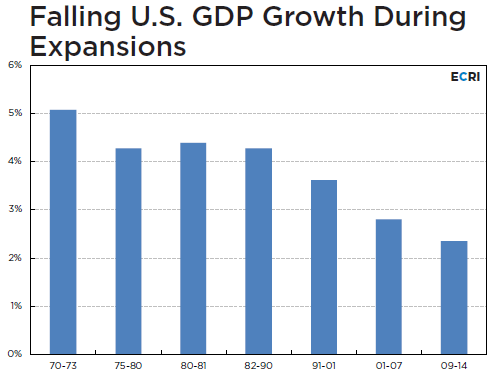
Providing the above chart, the ECRI shows us that a combination of demographic trends and government intervention is leading GDP lower.

Finally, Dr Lacey at Hosington has written one of the most accurate assessments I have read regarding the present economic conditions. You would be foolish not to read this article. You can get there by going to http://www.hoisingtonmgt.com/pdf/HIM2014Q4NP.pdf

Dr Lacey notes the DEFLATIONARY condition in the economy, CURRENCY MANIPULATION by the FED, OVER INDEBTEDNESS by governments, businesses, and individuals, and continued efforts by central banks to compete in an ever declining market.

SUGGESTIONS FOR INVESTORS

If you are invested, consider how much you are willing to lose and SET SELL POINTS. In other words determine how you are going to get out of the market. Don't wait too long to sell. The first out wins, the last out carries the losses.

If you are not invested, stay in cash until a firm downtrend has been established. Look for 30% to 50% losses. Only then could you consider re-entering the market. It is better to be out of the market wishing you were in, than to be in the market wishing you were out.

I have been positioned in a market, seeing losses each day; it is not a happy time. So walk carefully.

(Note: the above information is for ENTERTAINMENT purposes only and not to be used as investment advice)

Tuesday, February 17, 2015

Today's Market
by Dr Invest

Of course I'm not investing! I know I sound like a broken record, but everyone knows that this market has not performed on its own since May of 2012. Bernanke began buying bonds driving the price of bonds down to an almost a zero interest rate. But this action, which is simply money printing, drove the price of stocks up. There was an appearance of growing wealth at the expense of bond holders, but this over valuation of stocks has drive the PE ratio into the extraordinary.

I provide the example of COPPER. Copper has moved with the S&P and is an indicator of market strength. But since May of 2012, the price of copper has dropped, while the S&P has climbed. See graph below:


This would have been an indicator to SELL stocks. In the fall of 2012, copper and the S&P linked back up, appearing that there could be some market strength. But by January of 2013, copper had once again decoupled, falling to new lows while the S&P climbed to new highs. 

This is what we call DEFLATIONARY ACTION. Stocks climbed, but GOLD FELL.... Stocks climbed, but OIL FELL.....  Deflation is a recession, but our government has printed so much money, calling it GROWTH, that even wall street has begun to believe their own lie.

In Alex Rosenberg's article, titled Shiller is Back and has more Depressing News, he writes:
Nobel Prize-winning economist Robert Shiller has a grim message for investors: Save up, because in the years ahead, assets aren't going to give you the type of returns that you've become accustomed to. In his third edition of "Irrational Exuberance," which will drop later this month, the Yale professor of economics warns about high prices for stocks and bonds alike. "Don't use your usual assumptions about returns going forward." Shiller recommended to investors in a Thursday interview on CNBC's " Futures Now ." He says that stock valuations look rich. In fact, Shiller's favorite valuation measure, the cyclically adjusted price-earnings ratio (which compares current prices to the prior 10 years' worth of earnings) is "higher than ever before except for the times around 1929, 2000, and 2008, all major market peaks," he writes in his new preface to the third edition. "It's very hard to predict turning points in markets," Shiller said on Thursday. His CAPE measure of the S&P 500 (CME:Index and Options Market: .INX) "could keep going up. ... But it's definitely high. By historical standards, it's up there." Meanwhile, Shiller said that bond yields, which move inversely to prices, "can't keep trending down" and "could [reach] a major turning point in coming years." It's no surprise, then, that Shiller expects little in the way of asset returns-meaning Americans will have to rely more heavily on the piggy bank.
Read More Shiller warns bond investors: Beware of 'crash'! Given the current state of the stock and bond markets, "you might want to save more. A lot of people aren't saving enough. And incidentally, people are living longer now and health care is improving, you might end up retired for 30 years-people are not really preparing for that," he said. The other pillar of his advice is a classic tenant of responsible investing, with a global twist. "Diversify, because that helps reduce risk," Shiller said. "And you can diversify outside the United States. Some people would never invest in Europe-I think that's a mistake." Shiller adds that emerging markets can also provide attractive values. And indeed, valuations in much of the world are far lower than in the United States, given that investors are more optimistic about economic prospects in America than in nearly any other country. But perhaps people shouldn't base their investing decisions quite so heavily on predictions. "The future is always coming up with surprises for us, and the best way to insulate yourself from these surprises is to diversify," Shiller said.
Shiller is definitely not a 'PERMA BEAR', he is though, a BULL all the WAY. That is what has me worried, Shiller is warning all the other BULLS that this run can't last much longer. Stock are over valued like in 1929... (does that year mean anything to you?) and like 2000 and 2008.... 
Shiller believes that this bull run can't continue much longer. And the worry is that we could fall into even a more severe recession than in 2008. I do believe that market manipulation by the central banks will push economies into debt and default, including the U.S. 
THE ANSWER FOR YOU
Yes, I know, what can you do to avoid this on-coming collapse. When the market falls, it will fall fast. Called a FLASH CRASH, wall street already has technology in place to keep people from selling their positions to get out too quickly. So the first out, will be the ones who keep their gains. The major trading firms make those decisions and place trades within GIGASECONDS. Faster than you can blink an eye, they have already make their move. You can't compete with this kind of trading.
So you need to consider when you have enough gains, to move into a cash position. Listen, a bull market cannot last forever. We are well overdue for a MAJOR MARKET CORRECTION. To keep your profits, you have to move to a cash position. Typical losses in these corrections range from 43 to 58 percent. You can loose HALF your nest egg. In a month you can see a $500,000 reduced to $250,000. To regain your loss, your investment will need to grow 100%. 
So move out of STOCKS, and seek investments that are less volatile. Real Estate can be a very safe investment. Still, you will need to determine whether your area is in an economic decline before making that kind of investment. 
Gold has already been mentioned, as China and Russia are buying plenty of gold because it cannot be devalued by money printing.  The more money the government prints, the more expensive gold becomes. Gold is just a commodity, just metal. But it hasn't lost its glitter and continues to be the only real standard of value. I don't see that changing in the decades ahead.
In short, there are no real protections for a market that not a FREE MARKET and is manipulated by central banks. The value of Money, say the central banks, is what we say its is. They will learn the hard way that people will create their own currency, like bitcoin. Other experiments are with gold certificates, backed by real gold. The government hates these kind of competitors, because as the dollar becomes stronger against other currencies, it is actually growing weaker against the value of gold.
Finally, look at the chart below:
image
Just like COPPER, there has been a decoupling of DURABLE GOODS ORDERS from the S&P 500. And look where that decoupling occurs.... Yes, May of 2012. These charts are telling us something. The economy is not nearly as strong as our government is saying it is. Wall Street has joined right in with the government, crowing about how we are ready to have the greatest year ever. Yet the FUNDAMENTALS are telling us something very different and have been doing so since 2012. Excepting a brief SPIKE in 2014, new orders of durable goods has almost flat lined.
Even the decrease of unemployment is discouraging in that most jobs are part time and there are no significant increases in income paid to workers. This is indicative of economic weakness, not economic strength. 
(Note:the above information is not to be used in any way as investment advice and is for entertainment purposes only.)