Tuesday, May 20, 2014

Today's Market
by Dr Invest

Sure, some of you want to hear what I think. See, nothing has really changed. For the past two years, the economy has been in a downturn. Of course, your adviser has told you that the sky is full of gold for those who are bold, but he's lying. Look, the economy has been on "life support". If you don't believe it... then what would happen if, this afternoon, the FED withdrew all stimulus?

There is not one person in the room, who wouldn't agree that there would be an immediate and decisive collapse of the stock market and our economy from removing stimulus. The so called, STRONG ECONOMY, is smoke and mirrors presented by those wanting to create a WEALTH EFFECT. They think that people will start spending money and happy times will arrive once more by promoting something that just isn't happening in our economy.

The "take-off" of our economy just isn't going to happen. The past two years, a floundering market has pretended to be vibrant and powerful. To add to our misery, OBAMACARE amounts to a TAX,  that takes wealth from families. The recession...although no one has used the R word, has left millions of Americans poorer, as they have fallen out of the "middle class". Millions more have lost their homes and cannot leverage any kind of debt. Millions more can only find part-time jobs because companies have quit hiring FULL-TIME employees, so they wouldn't have to pay the government's demands for corporate sponsored healthcare. Again, thank you Obama!

Tax income for government is at all time lows, because people aren't higher incomes which is the basis for taxation. So local governments are increasing their taxes since there is not enough revenue from taxation. Perhaps you noticed that you paid more in Federal taxes this year. Sure, the Federal government is increasing taxes as well... And these taxes are on people who are already stretched financially.

HERE ARE SOME RECENT REPORTS

BlackRock Inc. (BLK)’s Chief Executive Officer Laurence D. Fink said the U.S. housing market is “structurally more unsound” today than before the financial crisis because it depends more on government-backed mortgage companies such as Fannie Mae and Freddie Mac. 
David Tepper is arguably the most influential “smart-money” voice in the markets right now. While hedge funds have persistently underperformed the market of late, there are at least a handful of talented money managers with some undeniably jaw-dropping track records. Tepper is in that category.
Tepper, who had previously been adamantly bullish, struck a decidedly cautious tone. He didn’t advocate a stampede for the exits, but he notably warned that it’s probably not a good idea right now to be “so  freakin’ long.” The interview was the signature event of this year’s conference. The nervous tone may have helped sink stocks on Thursday.


BI: What do you think is the most worrisome sign in the economy?

LA: While the consensus keeps predicting an economy at “escape velocity,” with sustained 3%-plus growth, the reality remains far short of that, with yoy GDP growth hovering around 2% – what one quickly-forgotten Fed paper had called the economy’s “stall speed.” Meanwhile, business investment remains elusive and – as ECRI correctly predicted last summer – construction is decelerating, not accelerating, posing risks to the economy now highlighted by Janet Yellen.

BI: What do you think is the most underreported story in the economy?

LA: The steepening downturn in home price growth has been obvious in recent months, with yoy growth having peaked last spring for median new home prices, and last summer for median existing home prices.  We predicted this downturn months in advance, over a year ago, and we expect it to continue.

BI: You've previously argued that the U.S. economy went into recession in 2012. What's the status of that call?

LA: In hindsight, the epicenter of the recession looks to be the half-year spanning Q4 2012 and Q1 2013, which saw just 0.6% annualized GDP growth, mostly from a jump in agricultural inventories. GDP growth for those quarters could easily end up negative after revisions, much of which tend to arrive years after the fact. Nevertheless, just looking at the data in hand, yoy GDP growth during that period fell to lows never seen away from recessions in over half a century. We'll see how the revisions change the picture in retrospect. (note: yoy is YEAR OVER YEAR)

IN CLOSING

Listen, if you are convinced that endless returns are the future and that the Federal Reserve has  successfully vanquished recession for all time, you need to put your money in the market right away. I, on the other hand, am highly suspicious that we are near a precipice that will result in many tears. 

This past week, I sat in a board meeting with a not-for-profit organization that had disbursed $20 million in funds. One board member brought in a book by Peter Schiff called, CRASH PROOF. The book was of lesser importance that the fact that intelligent men are nervous about this economy, and that should tell you something.  see: http://www.libertarianismo.org/livros/pscp.pdf

Let me use one word.... UNCERTAINTY. Those who I know, remain invested in the market but are not adding any new positions. The risk in the market is too high. And even those who have kept their long-term positions, have placed STOP-SELLs on their positions for the coming downturn in the market.

(note: the above information is for entertainment purposes only and to be used in any way as investment advice.)


Friday, April 11, 2014

yellen
Committed to Stimulate...FED Chairman Yellen
Today's Market
by Dr Invest

One of my favorite analysts is Louise Yamada. She suggest that the recent slides in the economy is not over yet. She says, "Worse yet, the selling could spread to other sectors, such as aerospace and consumer discretionary stocks. "What we're concerned about it whether or not some of the other stocks that have gone straight up are starting to move sideways, either in a consolidation or in preparation for some distribution," Yamada said, referring to a bearish pattern that indicates a market top. "It's a little iffy here."
What would cause real concern is if the S&P trades below 1,750. Yamada says the weakness in stocks lines up well with broader bearish indicators, such as the fact that 2014 started with a weak January, and is a midterm election year. But it's not all bad. The one positive, of course, is that 2015, as a year ending in 5, has a very good record of being an up year," the technician said. "That's the silver lining.
Thursday's edition of "The Gartman Letter," which is circulated before the opening bell, Gartman defended his recommendation to get out of stocks. "We stand by that decision, noting that we are not bearish of stocks; we are simply neutral." Thursday's big reversal wiped out the previous days' gains entirely, playing right into Gartman's notion. On "Fast Money" on Thursday, Gartman reiterated his opinion that the downturn is just getting started. "We heard a lot about the 200-day moving average in the S&P at 1760, my bet is that we probably go down and take a look at it," he said. That represents about another 4 percent of downside for the S&P 500 relative to Thursday's close. Gartman also elaborated on how long he's planning to stay on the sidelines. "Predominately, for the public, go to cash. I think it's the right place to be for a month or two, maybe even three at the outside most," he said.
My only reason for mentioning Gartman, is that he is perma-bull. I do get a bit nervous when I hear a perma-bull suggesting a downturn. Of course, in May of 2013 was a HEAD & SHOULDERS pattern that would have indicated an impending recession. Bernake managed to stimulate at the right time to avoid that crisis. Again in September of 2013 was another HEAD & SHOULDERS pattern that was put off by more of Bernanke's promises. We have  been assured by the FED and Yellen, that we are in an economic recovery, even a surge of economic health, while a reversal in trend is underway. Yellen has promised that she will step in to do whatever is necessary to continue the economic recovery, even though many on the Federal Reserve board are in disagreement with continued stimulus. The view is that continued stimulus will create new bubbles and distort even more the present economy. And they are right! Never the less, Yellen is projected to stimulate to the degree that it would even make Bernanke blush. 
So where from here? Expect a volatile market, dropping as much as 10%. If you are more bearish, we could see a 25% to 40% drop. The old adage, "Go Away in May!" could start in April. Do remember that Yellen will be making every effort to derail an impending recession. Much will be dependent upon the Federal Reserve and the Equities Markets selling the general public on the "strong economy" vision. Right now, however, it is the BIG CORPORATE INVESTORS who are getting out of the market. The Private investors only represent a small percentage of the equity market, but when the corporate investors make moves, those moves represent an investment tidal wave of change affecting the whole equities market. 
The big moves that you have seen in the past few days, represent a "taking of profits" from an equity market that is overbought and overvalued before a coming collapse. As for now, I remain no more committed to equities than I did in 2013. Yes, I know that 2013 provide the greatest of returns, but those returns came on the guarantee of government stimulus. That no stimulus been forth coming from the FED, what do you think equities would have done in 2013.... your'e right! Equities would have collapsed. And TODAY, what do you think would happen if Yellen said, "No more! I will not put another dime of taxpayer money into the market!" Yes, your'e right again! Equities would immediately collapse! 
It is for this reason, I prefer to miss these speculative opportunities. It may not be tomorrow, next month, or next year, but the FED cannot keep the market from entering into a recessionary period. I prefer not to invested in equities when that happens. 
(note: the above information is for entertainment purposes only and not to be used as investment advice.)


Monday, March 17, 2014


Today's Market
by Dr Invest

Dramatic rises and falls have marked the first part of 2014. Some traders love it, but for the average investor this kind of volatility is disheartening. I have not been making stock investments since 2013. I understand that I missed out on one of the best years ever in 2013, but in my estimation there exists a potential for a dramatic downturn without a corresponding upturn, a recession. 

With a bull market continuing for over 5 years now, the laws of averages are not in my favor. Oh, yes, people will rush into securities, only to get smacked in the next few months by mean market taking 40+% of their gains. Both in 2000 and in 2008, the declines in the market neared 50% and I have no reason to believe that future downturns will not result in a similar decline. 

You may say, "yeah, but I gained 15% last year!". When you loose 50% of the value of your stock, you have to make 100% to regain the value of your original investment. All thing considered, those who "stayed the course" have seen only a 15% rise over the past 5 years. Now if divide 15% by 5 years you get 3% per year in returns. Not quite that spectacular return of 115% touted by those wanting you to get back into the market. 

I sold my stocks in April of 2007, and re-entered in 2009, then stopped my stock investments at the end of 2012. My outcome is very different, because I didn't lose 48% of the value of you stocks in 2008 and I had some reasonable gains in my reinvestment. 

Many have said that 2014 will be an incredible year for investment. And I agree with that assessment, only that it will be an incredibly bad year. I would exercise caution in 2014 and 2015. I don't see how the economy will suddenly change, becoming an economic powerhouse. First, all the data suggests a tepid economy, and second, the demographics of an aging population lends itself to a declining workforce and less consumption. None of these things are supportive of a booming economy. 

What you will learn, is that there is a difference between a booming stock market and a booming economy.  The Fed can bolster the stock market... only for a short time, but the economy will eventually win. Debt and continued spending will result in economic bankruptcy.  Businesscycle.com and the ERCI can help you visualize the current economic condition. Also Hussmanfunds.com, under weekly reports, will provide you with important current information. Look in the sidebar for RESEARCH and REPORTS. 


Hussman, suggests that monetary reserves, created by the FED has to be held by someone. So liquidity, injected into the market, has to be absorbed. When you buy bonds or treasuries, you are buying the bloat. (the money injected into the market)


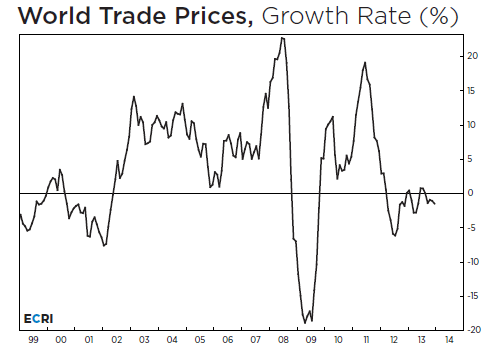
ECRI is demonstrating by the above chart, that rather than a robust world economy, we have depressed growth. Note 2008-2009    In 2012, began a recession. Efforts by the FED brought a small reflex from the market, but growth never really returned above the baseline. We could say that growth continues to trend downward. There isn't a strong likelihood that our economy will become ROBUST. 

Even though the overall returns in stocks trended upward, the overall trend of growth has been downward. Companies have reported increased inventory... that means that products are not selling.  Overall, people have less consumable income. Increase in TAXES, FEES, and HEALTH CARE can be thanked. And then employers, attempting to cut costs to remain profitable, have moved employees to 30 hour weeks as PART-TIME. That means many employees have seen decreases in their incomes. Finally, many of the unemployed, just haven't returned back to work. 

Stocks remain over valued, people remain under employed, and both state and federal governments continue to spend more and tax more; none of which suggest a robust economy. 


(the above information is for entertainment purposes only and not to be used as financial advice.)


Thursday, February 13, 2014

Today's Market
by Dr Invest

Tom DeMark, a financial analyst, began playing with a chart mostly out of fun. What struck him was the mirror image of his current chart with the collapse of the market in 1929. Many on Wall Street made accusations that he was simply matching the 1929 chart with a period of time where the 1929 graph would match with the current S&P graph.

But since November of 2013, many on Wall Street have been looking at that same graph.... and wondering....     See, without any help by Tom, the S&P graph for 2014 continues to unfold, following closely the 1929 graph. As you can imagine, many on Wall Street have begun to sweat bullets. Of course, no one is warning their customers to run, they can't! It would ruin business. We can't ruin business!

I learned this a few years ago, you investment adviser is going to get his 2% whether you lose 20, 30, or even 40%. He will get his reward, his payola, his bonus and all he needs to do is SELL you an investment. He is not about to move you to a safer investment, regardless how steamy it gets. He will say.... hold-on... one day it will get better.

Back to Tom DeMark. Here is his graph circulated around Wall Street. Enjoy!


As one analyst noted, it may not be exact, but it is enough to rhyme. Tom is suggesting that if the pattern continues that March to May will be the period of collapse. He also notes, that the government may be able to turn the collapse but only for a short while.

The very same thing occurred in 1929, there were attempts by banks to thwart the downturn and they did stop the drop for a while. Of course you know the rest of the story. The entire market eventually collapsed.

I am not suggesting that there is anything here more than a coincidence, but many of you know that I have stayed out of heavy investment in stocks. My persistence in keeping a cash position, has let me sleep at night. I will be keeping that restful position until there is indeed real strength in the market.

(note: the above information is for entertainment purposes only and not to be used as investment advice.)

Monday, February 3, 2014

Today's Market
by Dr Invest

Ill winds are blowing. The flow of thought is that we have soundly recovered from a 5 year recession, and all this due to the Federal Reserve's "quantitative easing". ALL INDICATORS, according to the government, are pointing to a strong economic recovery. And this is their analysis, after introducing new models for figuring UNEMPLOYMENT and GDP  in 2013 that relaxed the criteria in measuring these areas. Instead of an economy at ESCAPE VELOCITY, we are in an economy that is in tatters. Instead of reporting on the economy in a way that is accurate, many of the CNBC crowd are militantly against anything suggesting a market downturn.

Bernanke only reduced a portion of the Fed's monthly bond buying, resulting in the devastating downturn in the market. It is almost certain that Yellen, the new Fed chairperson, will resume QE and even bolster the program.

Economic Cycle Research Institute's Findings

The ECRI wrote:

Given the consensus that U.S. growth is about to “take off” and reach “escape velocity,” many would just ignore the December payroll jobs data, expecting it to be revised away. Yet, in the preceding 12 months the economy created 194,000 payroll jobs per month according to the establishment survey, but only 101,000 jobs per month according to the household survey, i.e., over a million fewer jobs over that 12-month period. Which is closer to the truth?

As the chart shows, over the past decade, the mean revision to the 12-month moving average of job growth, as measured by the household survey, was only one-twenty-fifth that for payroll jobs. Since their longer-term patterns tend to be similar, the payroll jobs data are more likely to be revised down. 

Separately, the household survey, adjusted to the payroll concept, actually shows a decline in employment since the summer. Bottom line: even ignoring the December jobs data, the trends are worsening, especially for data not subject to major revision.


Please visit their website and select some of the recent videos. Do note the attitude of some of the CNBC reporters. They are almost aghast at the suggestion that there could possibly be a problem with the economy. Their compass is clearly pointed toward the "strong growth" direction.

CLICK HERE: CNBC INTERVIEW

CLICK HERE: FOX NEWS INTERVIEW


Even with continued QE, the economy is tanking. The government's reporting of job increases are realistically much less and will be revised down. We have been in a recession since 2012. Yet the 30% stock market growth, doesn't reflect the REAL GROWTH which has remained flat through out 2013.

My Warning

You should be aware that new stimulus commitments by the Fed may result in arresting the deflation that is already occurring, but the government will not be able to continue that stimulus forever. Continued stimulus will flood the market with liquidity and produce super inflation when the market eventually returns to strength.

Worse case, we are headed for a season of deflation/recession. 2nd worse case, the government will stimulate to slow the deflation and may need to do so for a number of years, the result will be hyper-inflation should we return to seasons of economic growth.

(note: the above information is for entertainment purposes only and not to be used as investment advice.)

Friday, January 24, 2014

Today's Market
by Dr Invest

Only now are a few analysts beginning to agree with what I have been warning all along. We have a market that is largely rising on stimulus, cut the stimulus and the market will fall. The Federal Reserve is only testing the waters because they want to see if the market could really recover. Let me reassure you... it won't! Either the Federal Reserve will have to let the market fall as we slip into VALUE DESTRUCTION or try to artificially stimulate the economy to VALUE CREATION.

Look, if you value a bottle of coke at $1.00 and I offer $1.10 per bottle, then someone else offers $1.20 per bottle, VALUE IS BEING CREATED. But when a bottle of coke rises to $10 per bottle of coke, I'm gonna sell my case of coke bottles to the highest bidder. Assuming you have a computer screen that could log all the COKE bottles being sold, you may say to yourself...you could make a bottle of coke for .45 cents and $10 is OVERVALUED.... an assume everyone else came to the same recognition....everybody would begin selling their BOTTLES OF COKE. Perhaps on one would buy them any longer at $10, but would buy them at $9. You would say the VALUE is DECREASING. That is what we call VALUE DESTRUCTION. Some might buy coke bottles at $9, but when they saw that other people were offering to sell at $7 or $6 or even $5, the speculators would rush to get rid of their coke bottles as well.

Now suppose that our Federal Government came and offered to buy all coke bottles at $10 again. You would feel better about keeping your coke bottles that you paid $10 for. VALUE DESTRUCTION would have been STOPPED and people may again enter into VALUE CREATION by bidding up COKE BOTTLES at the new base price of $10 held by the Government. So in a month, or six months or a year, a bottle of coke would be valued at $15.

But what happens when the Government no longer promises to keep the value of a bottle of coke at $10.  Speculators have been working from at BASE PRICE of $10, but now they are realizing that to make a bottle of coke only costs .45 cents. Not only has the value of a bottle of coke been overvalued, that value has been driven even higher by the help of the government... and speculators have suddenly realized that when the Government leaves, they will be holding an OVERVALUED bottle of coke.

Now what do you think the speculator will do? He will sell, sell, sell. And someone, usually the small investor, will be held with the bottles of coke that are destined for VALUE DESTRUCTION.

I don't know if you followed the above story, but we are near the point of catching a falling knife. I believe that the Federal Reserve will begin withdrawing stimulus, but will have to re-enact stimulus to keep VALUE DESTRUCTION from reaching a maximum velocity.

I would look for the Federal Reserve to resume their stimulus somewhere between March and May. It would be the only way to restore market confidence should we continue this present slide in the stock market.

I will be writing more, but as for now, I see no real opportunities for the small investor. The present risks outweigh the reward, as they have for the past two years. You may feel you have lost out on great returns, but you're wrong. Stock could fall 10 to 30%, then you would be ready for some real returns and safe returns.

(note: the above information is for entertainment purposes only and not to be used as investment advice)

Sunday, December 1, 2013

Today's Market
by Dr Invest

Over the past months, the market continues an upward climb. One would think that we are setting on an economic rocket. While the GDP is expected to grow barely over 2%, growth projections over the next 10 years for the GDP is estimated at only around 1.8%.

The problem is that a double digit growth in commodities in 2013 doesn't reflect the actual weakness in the economy. Analysts have acknowledged that the economy is weak and will be even weaker in 2014 because of increased taxes from Obamacare. Adding to the increase in taxes is the requirement that families purchase medical insurance. Even with subsidies, the poor will see a drain on their total income as they pay something for their health insurance. This means less money per household for consumables. This is why the projection is decreased for overall GDP. When you don't have extra money to spend, you put off buying a car, a washing machine, a television, a computer...etc. The economy never heats up... it can't heat up, because the economy is stagnant.

The greatest fear is that we will return to the STAGFLATION of the 70s. Government stimulus pushes prices higher, but taxation and debt bring recession as people have less to spend. Experimental Economics will result in even larger bubbles and the outcome will result is great sorrow. The poor will become poorer, the middle class will slip into poverty, and the wealthy will become less wealthy. Because people are earning less, state and national government will collect less taxes and pressure will be put upon politicians to tax the wealthy even more.

There is no significant growth in the economy, but rather a significant slowing. Stocks are being priced in at some FUTURE value, but when it is clear that that "future value" cannot be achieve, there will be a sudden sickening sell-off.

Knowing that the economy is deteriorating, I couldn't risk the potential losses that are sure to come. I continue to hold some bond positions and a few stock positions but believe that a downtrend will begin in the first six months of 2014. As I have already said, the economy has deteriorated over the past two years. The government has set new guidelines for the CALCULATION OF INFLATION, the CALCULATION OF UNEMPLOYMENT, and the CALCULATION OF GDP that makes the economy appear more robust that it actually is. Everyone knows that this is simply a "fudging of numbers" and "creative accounting". If you or I did the same kind of accounting, we would be immediately charged for criminal conduct.

SUGGESTIONS

If you are already in a stock position, keep a stop-sell on your positions. For example, if you have seen an increase of 15%, a stop-loss set at 10% might be acceptable for 2013. If the new Fed Chairman keeps stimulating, your stocks could rise even further until a collapse in the market is achieved. If you do not hold stock positions, don't buy them now. Stay away! Stocks are overvalued and overbought. Go buy a good certificate of deposit until the storm passes.

The above information is for entertainment purposes only and should not be used as investment advice.